
Salt Lake Court Records After Arrest
After a Salt Lake County arrest, the first public trail may be the jail record. That record can show booking-side information such as the booking number, agency, jail custody, and charges listed at intake. The court case starts when a prosecutor files a charging document or when a court creates the case tied to the arrest. In Salt Lake County, the District Attorney's Office is the key prosecutor for felony and many criminal matters, while city prosecutors may handle some municipal or justice-court misdemeanors and infractions.
The Salt Lake County District Attorney's Office receives law-enforcement referrals, screens cases, files charges where appropriate, and handles felony prosecutions and assigned criminal matters. Utah's Third District Court serves Salt Lake County for district-court cases, while justice and municipal courts can handle lower-level matters by jurisdiction. The key point is simple: booking charges are not the final court record. Prosecutors may file fewer, more, amended, reduced, or different charges than the arrest-side jail data.
Custody details remain with the jail roster and jail records. Booking-photo questions belong with the jail roster and records process, not the court case search. For custody and booking fields, use Salt Lake jail inmate records. For booking photo access limits, use Salt Lake jail roster mugshots. Court records after a jail arrest should be read for the filed case and its legal status.
Search Salt Lake Court Records
Utah Courts provides the official court-record access path. The main statewide information page is the Utah Courts public records overview, and remote case search is through XChange. XChange is not a free open-web index. Utah Courts describes it as an electronic case-record system, and remote use requires an account or subscription. Public courthouse terminal access may be available under court rules, which matters for people who cannot use paid remote access.
- Confirm the jail booking first if the person was just arrested or may still be in custody.
- Allow time for prosecutor filing and court case creation because booking can happen before charges appear.
- Search Utah Courts XChange by defendant name, or use a case number if it is known.
- Filter for Salt Lake County, Third District Court, justice court, municipal court, criminal case type, or filing period when those filters are available.
- Open the case summary and compare filed charges with the booking charges from the jail record.
- For sealed, old, or unavailable files, contact the correct court clerk or use the court's records process.
The official Utah Courts XChange information page is the source for the case-search access model shown here.
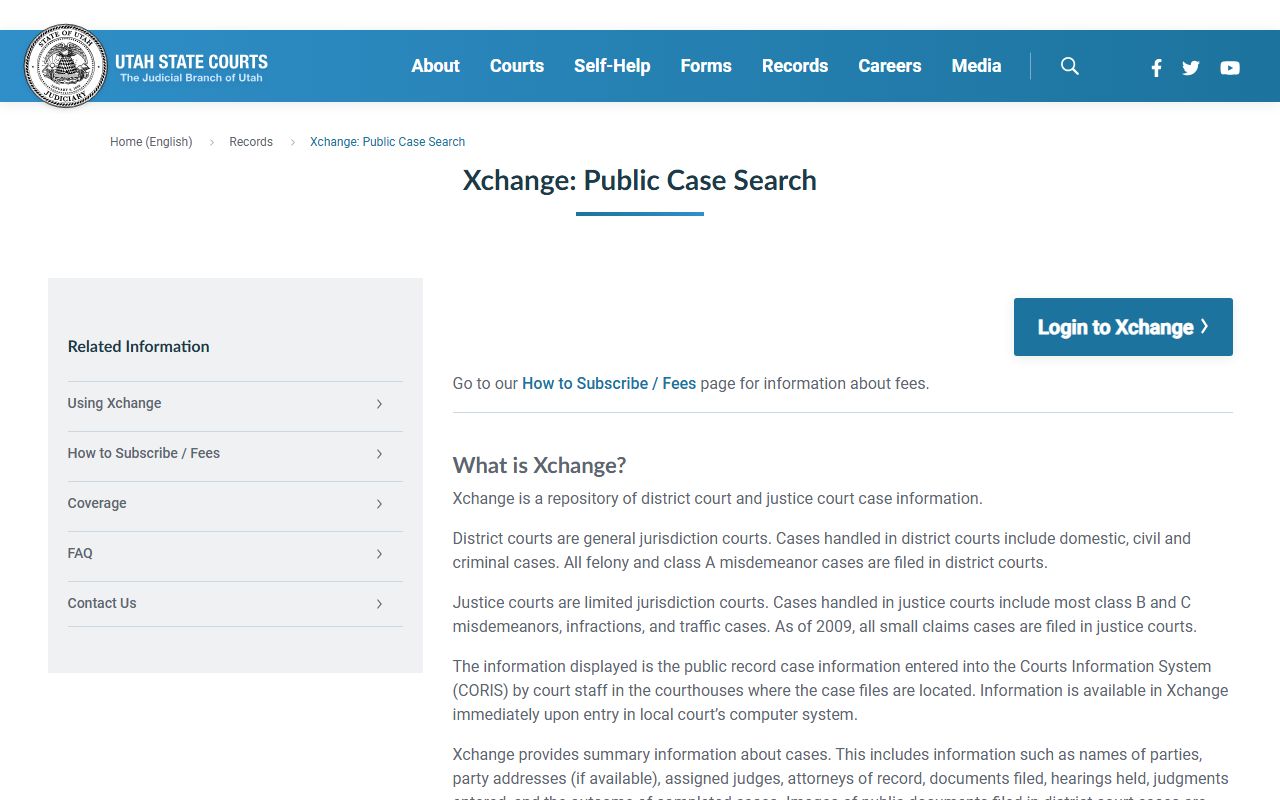
XChange is a court case channel, so it should be paired with jail lookup only when custody or booking status is also needed.
Salt Lake Court Search Fields
The Utah Courts research supports a high-level search-field table rather than a promise that each field appears in every access context. Remote XChange access and courthouse terminal access can differ. Court and clerk rules can also limit what is visible in sealed, juvenile, expunged, protected, or otherwise restricted cases. Use case number when available because names can be common, misspelled, or formatted differently across jail and court systems.
| Field or Access Point | Type | Required | Notes |
|---|---|---|---|
| XChange account/login | Account or subscription | Yes for remote use | Utah Courts describes XChange as an electronic case-record system. |
| Public terminal access | Courthouse terminal | No remote account | Available at court locations depending on terminal access and rules. |
| Party name | Search field | Depends on search | Use the defendant name from the arrest or booking record. |
| Case number | Search field | Optional if known | Best precision for a filed criminal case. |
| Court or location | Filter | Optional | Use Third District Court or Salt Lake County where available. |
| Date range or case type | Filter | Optional | Can narrow recent post-arrest criminal filings. |
Salt Lake Charging Records
The charge record begins with a formal charging document or court case entry, not with the jail intake screen alone. A complaint, information, or indictment can start or define the case depending on the charge and procedure. The exact document controls the court record. It should be compared to the booking record rather than assumed to match it word for word.
| Document | Who Files It | Common Use | Why It Matters |
|---|---|---|---|
| Complaint | Prosecutor or charging authority | Often starts a criminal case | Lists the filed accusation and case basis. |
| Information | Prosecutor | Common for felony charging after screening | Can replace or refine arrest-side charge language. |
| Indictment | Grand jury process | Less common, serious matters | Starts charges through grand-jury action. |
Salt Lake County court records after a jail arrest may also include first-appearance orders, pretrial release terms, no-contact orders, warrants, amended charging documents, plea records, dismissal entries, sentence orders, and transfer or commitment documents. Not every case has each type of entry.
Salt Lake Charge Status
Charges change as cases move through screening, negotiation, hearings, and disposition. A pending charge remains active. An amended charge has changed from the original filed count. A reduced charge has been lowered, often by plea or amendment. A dismissal ends a count without conviction on that count. An acquittal is a not guilty finding. A conviction is a guilty plea, verdict, or other conviction outcome. Disposition means the final outcome of a charge or case.
| Status | Meaning in a Court Record |
|---|---|
| Pending | The charge remains active and has not reached final disposition. |
| Amended | The prosecutor or court changed the original charge language or count. |
| Reduced | The charge was lowered by plea, negotiation, amendment, or court action. |
| Dismissed | The count ended without conviction on that count. |
| Acquitted | The defendant was found not guilty on that charge. |
| Convicted | The record reflects a guilty plea, verdict, or other conviction outcome. |
Salt Lake Bail Records
Bail and release after a Salt Lake County arrest are controlled by Utah Code Title 77, Chapter 20 and by the court order in the case. The jail can accept payment when a person is eligible for release, but the court determines conditions. Salt Lake County's official fine and bail page says to look up the prisoner's SO#, use the Metro Jail for in-person bail or fine payment, and make cashier's or certified checks payable to the Salt Lake County Treasurer. Bail is accepted 24 hours a day, 7 days a week. Cashier's and certified checks must be verified during business hours.
| Release Type | How It Works |
|---|---|
| Cash bail or bond | Money posted with the court or jail to secure appearance and compliance. |
| Surety bond | A licensed bond agent posts security where allowed by the court order. |
| Personal recognizance | Release based on promise and court conditions rather than cash. |
| Conditions of release | No-contact orders, monitoring, travel limits, treatment, or supervision terms. |
| No-bond hold | Payment alone will not release the person. |
| Agency detainer | Another court, county, DOC, federal, or ICE issue may keep the person in custody. |
Salt Lake Arrest Warrants
A warrant can be the reason a person enters Salt Lake County jail. The research identified the Salt Lake County Sheriff's warrants page and the official Utah statewide warrant search portal. A warrant search may involve a sheriff page, the statewide portal, a court clerk, Utah Courts records, or a GRAMA request depending on the status and public availability. The statewide warrant portal blocked command-line inspection during research, so exact form labels were not captured and should not be invented.
The warrant-to-jail path usually runs from court order, to law-enforcement confirmation, to arrest, to jail booking, to bond or hold review. A bench warrant often follows a missed court date or violation of a court order. An arrest warrant authorizes custody on a criminal case. A search warrant authorizes a search and is not itself a custody roster entry. A probation, parole, fugitive, federal, or ICE hold can also affect release even when one Salt Lake County case has a bond amount.
Charges vs Convictions
An arrest and a filed charge are accusations, not a conviction. A conviction requires a guilty plea, guilty verdict, or other conviction outcome recognized by the court. Salt Lake County court records after an arrest should be read count by count because one charge may be dismissed while another is amended or resolved by plea. The final disposition is the best place to check the legal outcome of a charge.
| Point | Charge | Conviction |
|---|---|---|
| Stage | Filed accusation after arrest or prosecutor review. | Final guilty outcome by plea, verdict, or related court action. |
| Proof | Based on filing standards and probable cause process. | Requires conviction-level process and court disposition. |
| Record meaning | Shows what was alleged or pending. | Shows legal responsibility for the charge. |
| Can change | May be amended, reduced, or dismissed. | May later be affected by appeal, set-aside, or expungement if eligible. |
Sealed and Expunged Records
Utah's expungement law is in Utah Code Title 77, Chapter 40a. Expungement can limit public access to eligible criminal records after the required process, but eligibility depends on the case outcome, offense type, waiting period, criminal history, and court order. GRAMA also classifies some records as private, protected, controlled, or restricted. That means a Salt Lake County court record after a jail arrest may be public in one case and restricted in another.
| Issue | Sealed or Restricted | Expunged |
|---|---|---|
| Public view | Hidden or limited from ordinary public access. | Treated under Utah expungement procedures after court action. |
| How it happens | Statute, court rule, case type, or specific order. | Eligibility review and expungement order under Title 77 Chapter 40a. |
| Examples | Juvenile, protected, private, victim, or ongoing-investigation material. | Eligible dismissal, acquittal, or conviction record after statutory process. |
| Where to check | Court clerk or Utah Courts access rules. | Court expungement order and official record-holder compliance. |
Utah Court Access Laws
GRAMA, Utah Code 63G-2-201, is the baseline public-records access statute, but it does not make every record public. Utah Code 63G-2-301 defines private records and helps explain why identifiers such as birth dates can be removed from public jail displays. Utah Code Title 77, Chapter 20 governs pretrial release, detention, bail, and release conditions. Utah Code Title 77, Chapter 40a governs expungement. Court access also depends on Utah Courts rules, court clerk procedures, and case-specific orders.
Important: Court, jail, and custody records are not consumer reports and should not be used for FCRA-covered decisions.
Restricted Salt Lake Court Records
Not all court records after a Salt Lake County arrest are available by remote search. Juvenile records, sealed charges, expunged matters, victim information, protected addresses, medical details, some investigative records, and other private or protected data may be withheld or redacted. Older cases may require clerk research or a formal request. A record that is missing from a remote index is not proof that no arrest, case, warrant, or dismissal exists.
Use the source that created the record. The sheriff controls jail booking records and GRAMA requests for jail records. Utah Courts and the relevant clerk control court case files. The District Attorney's Office controls prosecutor records subject to its own legal limits. UDC, BOP, ICE, and VINELink each control a different custody or notification function.